
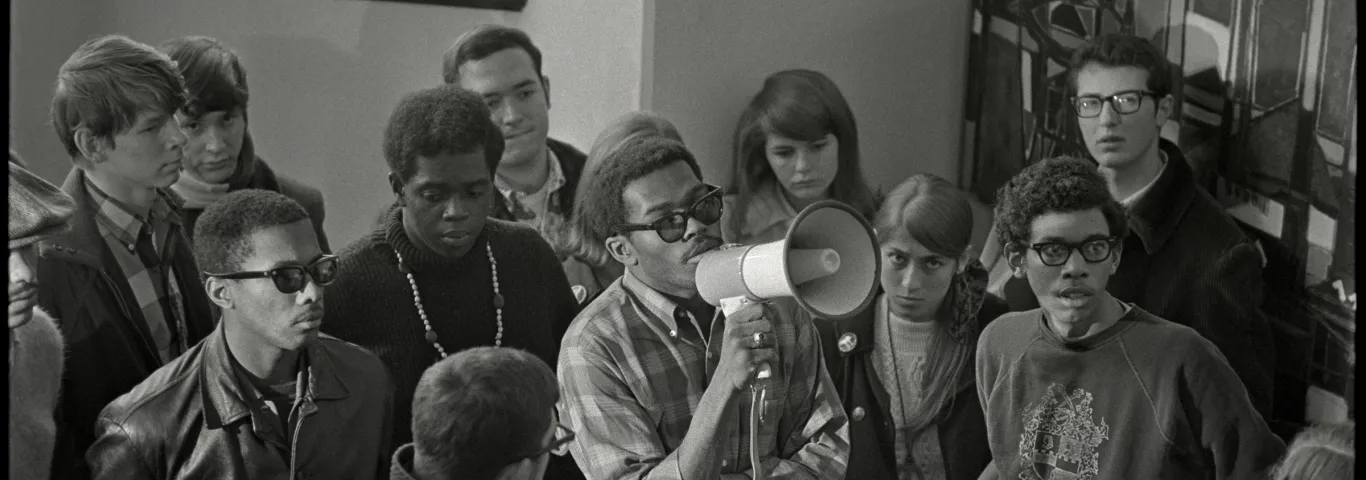
Black Studies and the Future of the American University

""

Black Studies and the Future of the American University

About the seminar

Across the United States, academic freedom faces growing challenges. Debates over curriculum, speech and institutional governance raise urgent questions about the role of the university in a democratic society. At the same time, as universities become increasingly reliant on private funding, tensions are emerging between faculty and student research and the interests of donors, foundations and corporate partners. Further, Missouri has become a key site for legislative efforts to shape educational curricula. Some argue that these interventions risk limiting the range of perspectives and critical analyses essential to understanding history and contemporary social life.

These conditions create a critical moment for examining how universities can sustain open inquiry, inclusive knowledge production and democratic engagement.

This Sawyer Seminar, convened by Department of African and African American Studies and the Center for the Humanities, examines how Black studies can help sustain academic freedom and reimagine democratic higher education. The seminar unfolds through a yearlong series of themed conversations that bring together faculty, students, community partners and national leaders. Collectively, participants will examine how Black studies — an interdisciplinary field that draws from disciplines such as anthropology, education, history, literature, political science, psychology and sociology to understand structures of power, inequality and resistance — is a vital framework for understanding the past, navigating the present and shaping the future of higher education.

Seminars take place monthly, September 2026 through May 2027, each featuring public events and smaller convenings of university and community members.

Seminar Themes

HISTORY AND TRANSFORMATION

We examine the emergence of Black Studies and its transformative role in democratizing access to higher education and reshaping knowledge production across disciplines.

CONTEMPORARY CHALLENGES

We explore the current landscape in which Black studies is both the object of political and institutional attacks and a field uniquely equipped to analyze and respond to those pressures.

FUTURES AND INSTITUTIONAL CHANGE

We consider how Black studies can lead the development of new structures, collaborations and models for a more democratic and publicly engaged university.

Academic Freedom and Democracy

Why Black studies?

Black studies is a humanistic, transdisciplinary field that has been central to the transformation of higher education since the 1960s. It offers critical tools for understanding race and racism, power, inequality, law and social change while expanding whose histories, perspectives and cultures are recognized within the university.

• A driver of institutional transformation
• A model for engaged, community-centered scholarship
• A framework for connecting knowledge production to democratic life

“Black studies was always meant to be beyond the walls … because that’s where the world was.” — Robin D.G. Kelley, “Black Studies vs Fascism: The Longue Durée”

Join the conversation

This seminar brings together ideas, people and institutions to imagine and build a more just and democratic future for higher education. Sign up for our mailing list to receive event announcements and reminders for a full academic year of programming.

Sign UP

Organizers & project team

This seminar is jointly convened and organized by the faculty leaders of the Department of African and African American Studies and the Center for the Humanities.

Marlon M. Bailey

Professor of African and African American Studies; Women, Gender and Sexuality Studies; and Faculty Affiliate in the Performing Arts Department and the Center for the Study of Race, Ethnicity and Equity
Chair, Department of African and African American Studies


Stephanie Kirk

Professor of Spanish; Comparative Literature; and Women, Gender and Sexuality Studies
Director, Center for the Humanities


​Shanti Parikh

Professor of Sociocultural Anthropology and African and African American Studies
Past Chair, Department of African and African American Studies


Project team

Ameen Animashaun

Academic and Administrative Coordinator, Department of African and African American Studies

contact

Alex Keith

Postdoctoral Fellow, Sawyer Seminar: Black Studies and the Future of the American University

Meredith Kelling

Assistant Director for Student Research and Engagement, Center for the Humanities

contact

Laura Perry

Project coordinator
Assistant Director for Research and Public Engagement, Center for the Humanities

contact

Gabrielle Weeden

Community & Program Coordinator, Department of African and African American Studies

contact

Speakers

Every month from September 2026 through May 2027, members of the university community and the public at large are invited to engage in themed conversations featuring some of the leading thinkers of Black studies. Scan the event schedule below or click on the button to find the full lineup on our event page.


ALL EVENTS


RESOURCE 

Black Manifesto (1968) 

A landmark statement outlining Black students' demands for institutional change at Washington University


Black Manifesto (1978) 

An update of the original document with insights from the program’s 10-year review and continuing calls for action


Black Manifesto (1983) 

A third update of the document, raising continuing concerns about the enrollment of Black students, tenure for Black faculty and administrative structure for Black studies at WashU


Black Manifesto (1998) 

On the 30th anniversary of the original document, the Association of Black Students released an updated call to action


Fifty Years of Black Activism and Study 

A timeline of departmental and institutional change in Black studies at WashU

“Remembering James McLeod and the Rise of Black Studies at Washington University"

Transcript of Gerald Early’s 2021 McLeod lecture


“‘We Are Not White. We Don’t Want to Be White.’: Washington University’s Black Radical Awakening” 

AFAS alumna Olivia Kerr’s interviews with participants in the 1968 Brookings Hall Occupation


Students for a Democratic Society 

A leading national organization in the radical white student movement in the 1960s, its members were key allies for WashU’s Association of Black Students